The One Wall Trick to Reduce Echo at Home (Without “Soundproofing” the Whole Room)
Hard floors and bare walls can make rooms feel loud. Learn the simple “soft wall” approach—using everyday items—to cut echo and make spaces calmer.
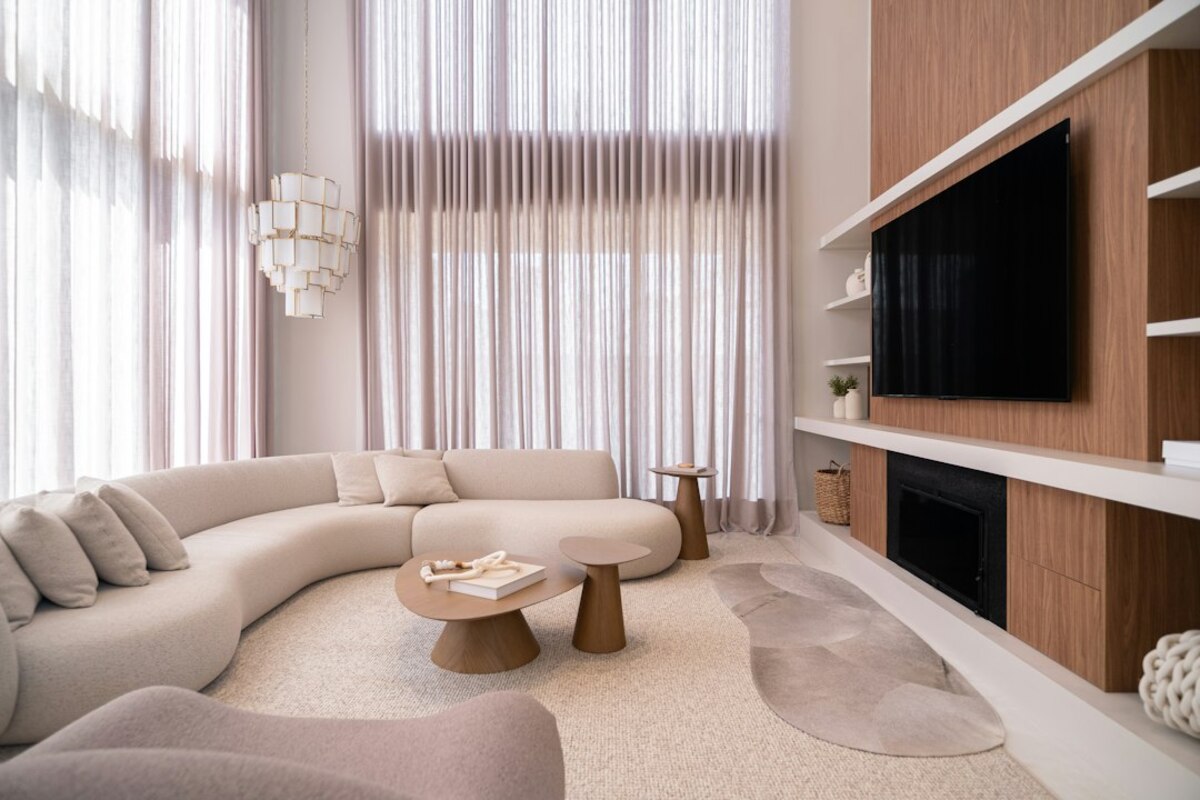
- Echo is usually a “too many hard surfaces” problem, not a “thin walls” problem
- Treating just one key wall (the one you face most) can noticeably reduce harshness
- Rugs, curtains, bookshelves, and fabric panels work best when you place them intentionally
Why your room sounds louder than it should
Have you ever walked into a mostly finished room—painted walls, nice flooring, a couch, a table—and thought: “Why does this sound like a cafeteria?” You’re not imagining it. Many modern interiors are full of surfaces that are great for looks and easy cleaning, but not great for sound.
Here’s the simple idea: hard, flat surfaces bounce sound. The more sound bounces around, the longer it hangs in the air. That lingering, splashy sound is what we call echo (or more accurately, “reverb” in a normal-sized room). You notice it when:
- Calls feel harsh or people sound “tinny” on speakerphone
- TV dialogue feels messy unless the volume is high
- Clanking dishes and footsteps feel extra sharp
- Small talk feels tiring because voices bounce around
Important distinction: a room can be “echoey” even if it isn’t “noisy.” Echo is mostly about sound inside the room bouncing. Noise complaints about neighbors are often about sound coming through walls. This article focuses on the first one—because it’s the easiest to improve with normal decor.
Think of sound like a rubber ball. In a room with tile floors, bare drywall, and big windows, you’re basically in a racquetball court. In a room with fabric, books, and soft textures, the ball hits things that absorb or scatter it instead of returning it cleanly.

The “one wall” approach: build a soft wall where it counts
You don’t need to treat every surface. A surprisingly effective strategy is to make one wall significantly softer than the rest. This is not about a fancy renovation; it’s about adding materials that either absorb sound (fabric, thick textiles) or break it up (books, irregular shelves) so it doesn’t bounce straight back.
Which wall should you choose? Start with the wall that’s most “in the line of fire” of your daily sound:
- Living room: the wall you face while watching TV (often behind the TV or opposite the seating)
- Home office: the wall behind your monitor or behind your chair—whichever makes your voice sound boxy on calls
- Dining area: the wall closest to the table, especially if it’s bare and flat
- Bedroom: the wall opposite the bed (often the emptiest wall)
Why one wall helps: in many rooms, sound bounces between parallel surfaces like ping-pong. If you make one major surface less reflective, you reduce the “back-and-forth” energy that keeps the room sounding sharp.
| Room symptom | What’s usually causing it | Best “soft wall” move |
|---|---|---|
| TV dialogue sounds unclear | Sound reflecting off bare wall/floor near TV | Thick curtains + rug + something soft/irregular on wall near TV |
| Video calls sound echoey | Voice bouncing behind/around your desk | Fabric panel(s) or bookshelf behind monitor; avoid empty wall right behind mic |
| Dining feels loud with guests | Hard table + bare walls = lots of reflections | Large art with fabric backing, tapestry, or curtains on nearest wall |
When people hear “acoustic treatment,” they imagine foam tiles and recording studios. The reality for everyday interiors is more like: curtains, rugs, upholstered furniture, bookshelves, and a few well-placed fabric panels.
Below are practical “soft wall” options, from most normal-looking to more purpose-built.
Option A: Curtains on a wall that isn’t even a window
This sounds odd until you see it done well. Hanging curtains across a blank wall (especially floor-to-ceiling) creates a huge soft surface. It can look intentional—like a backdrop—if you pick a solid color or a textured neutral and mount the rod high and wide.
- Best for: rentals, multipurpose rooms, big blank walls
- What works: heavier fabric, generous fullness (more folds = more absorption)
- Bonus: hides storage, cords, or an awkward wall
Quick scenario: Your home office is in the corner of a living room. Calls sound hollow. A curtain rod mounted high on the wall behind your desk, with thick curtains pulled closed during calls, can take the “bathroom” edge off your voice.
Option B: A bookshelf or media unit that’s actually filled
An empty shelving unit is mostly a hard surface. A shelf filled with books and varied objects becomes an irregular landscape that scatters sound rather than reflecting it like a mirror.
- Best for: living rooms, offices, hallways
- What works: mixed depth (some books pushed back, some forward), a few baskets, some uneven shapes
- Avoid: perfectly uniform rows of identical items (better than bare, but less effective than irregular)
If you’ve ever noticed how quiet a library feels—even though it’s full of people—that’s the “soft wall” idea in action: lots of paper, lots of texture, lots of sound getting absorbed or broken up.
Option C: Upholstered wall art (the stealth acoustic panel)
You can reduce echo with panels that look like decor instead of “equipment.” Many acoustic art panels are printed like canvas art. Or you can DIY a simple version: a wooden frame, rockwool or dense insulation, and a nice fabric wrap (if you DIY, follow safety guidance for insulation materials and sealing).
- Best for: rooms where you want a clean look (offices, bedrooms)
- What works: panels placed at ear level where sound bounces
- Tip: two medium panels often beat one small one
Real-life use: In a living room with a big TV and hardwood floors, adding two fabric panels on the wall opposite the sofa can make speech feel less “spitty” without changing your layout.
Option D: The “soft + irregular” combo wall
This is the most effective and still looks normal: combine an irregular element (bookshelf) with a soft element (curtains or a large textile piece). You’re covering both bases—absorption and scattering.
To keep it simple, try this placement rule: treat the wall that faces your main seating. If your couch faces a bare wall across the room, that wall is a prime suspect for slap-back reflections. Softening it changes how the whole room feels.
How to set it up in a weekend (and actually notice the difference)
The biggest reason people don’t feel improvement is that they make a small change in the wrong place—like a tiny rug in a large echoey room. Here’s a weekend plan designed to produce a difference you can hear.
Step 1: Do the 10-second echo check
Stand where you normally sit. Clap once (not repeatedly). Or speak a short sentence at normal volume. Listen for a “tail”—that lingering brightness after the sound.
Then turn your head toward different directions and clap again. Often you’ll notice the echo is worse when you face a particular wall or window. That’s the wall to soften first.
Step 2: Pick one “soft wall” solution and go big enough
Sound improvements are about coverage. A small soft item on a large reflective wall won’t move the needle much. Choose one of these “big enough” targets:
- Curtains: at least the width of the wall section you’re treating, ideally floor-to-ceiling
- Bookshelf: tall and filled (a low shelf can help, but tall is better)
- Panels: 2–4 panels roughly poster-sized, spaced with a little gap
Analogy: If sunlight is blasting into your room, a small coaster won’t fix it. You need a curtain, a shade, or a larger change. Sound is similar.
Step 3: Don’t forget the “sound mirror” surfaces near it
A “soft wall” is even more effective when the nearby surfaces aren’t all hard. You don’t have to redo the room—just avoid a perfect storm of reflective surfaces. Here are small pairings that help:
- If you add curtains on the wall: add a rug or runner on the floor near that wall
- If you add a bookshelf: add one soft item nearby (a floor lamp with a fabric shade, a padded chair, a throw blanket)
- If you add panels: keep a soft furnishing (sofa, rug) in the room so you’re not treating only one spot
Step 4: Test like a normal person (not with instruments)
Use a scenario you actually care about:
- Play a dialogue-heavy show at your usual volume and see if you stop reaching for subtitles
- Make a voice memo in the room before and after, standing in the same place
- Take a call on speaker and ask the other person if you sound less “roomy”
If the improvement is subtle, you may have treated a wall that wasn’t the main reflector—or the room simply needs more soft coverage (often the floor, if it’s bare wood/tile).
No. Soundproofing is about stopping sound from traveling through walls, floors, or ceilings (construction, mass, sealing gaps). This article is about reducing echo inside the room, which is typically easier and cheaper using soft and textured surfaces.
No. Soundproofing is about stopping sound from traveling through walls, floors, or ceilings (construction, mass, sealing gaps). This article is about reducing echo inside the room, which is typically easier and cheaper using soft and textured surfaces.
Usually: textiles you may already own. Try moving a thick rug, hanging extra curtains, or placing a filled bookshelf on the most reflective wall. Even temporarily hanging a quilt or blanket (neatly) can prove the concept before you spend money.
Usually: textiles you may already own. Try moving a thick rug, hanging extra curtains, or placing a filled bookshelf on the most reflective wall. Even temporarily hanging a quilt or blanket (neatly) can prove the concept before you spend money.
Decluttering often removes soft, irregular items—pillows, throws, stacks of books, fabric baskets—and leaves behind clean, hard planes. The room may look calmer but sound harsher. The fix is not re-adding clutter; it’s adding intentional softness (a rug, curtains, upholstered pieces, or neat panels).
Decluttering often removes soft, irregular items—pillows, throws, stacks of books, fabric baskets—and leaves behind clean, hard planes. The room may look calmer but sound harsher. The fix is not re-adding clutter; it’s adding intentional softness (a rug, curtains, upholstered pieces, or neat panels).
A note on expectations: If your main issue is hearing neighbors or traffic, a “soft wall” won’t fully solve it. But for the everyday problems people complain about—sharp-sounding rooms, tiring conversations, echo on Zoom—this is one of the highest-impact changes you can make without renovation.
The best part is that you can test it before committing: hang fabric temporarily, move a bookcase, lay down a larger rug. When the room suddenly feels less “live,” you’ll know exactly what direction to take—then you can upgrade the look at your own pace.